
A “Heartfelt Merger” or a Dissolution?
Exhibit curated by Eden Wolde.
Online adapation by Erica Buddington.
Analyzing the Implications of Resolution 12 for Black Teacher Associations.
As you journey through the Black Teacher Archive, you may notice that the journal publications end by the mid-1970s and perhaps you wonder, “What happened?”
Resolution 12 happened.
Ten years after the monumental Brown v. Board of Education Supreme Court decision and just one day after the signing of the Civil Rights Act of 1964, the National Education Association (NEA) passed Resolution 12, mandating the removal of “restrictive membership requirements dealing with race, creed, or ethnic groups” and the development of “plans to effect the complete integration” of state dual affiliates associations.

North Carolina Teachers' Record Vol. 34, No. 4 (gut50000c04746) Pages from the North Carolina State Teachers Association's official organ, featuring a transcription of Dr. Charles A. Lyons's speech at the NEA convention where Resolution 12 was passed, along with an overview of the resolution announcement.

North Carolina Teachers' Record Vol. 34, No. 4 (gut50000c04746)
Consequently, Black teacher associations (referenced in this exhibit as Colored Teacher Associations [CTAs]) were expected to merge with White teacher associations, even though it was White teacher associations that had racialized restrictions to membership.

Newsletter Vol. 11, No. 3 (gut50000c04804) details how White teacher associations had to remove racial restrictions for membership shortly after Resolution 12.
Nonetheless, CTAs were up for the task, assembling a strategic arsenal to defend their institutions from complete dissolution — their vocational viability depended on it.
At the time of Resolution 12, the landscape of Black education was challenging with the inequitable ramifications of Brown v. Board, including the closing of Black schools and the demotion or "dismissal without notice" of at least 38,000 Black teachers and administrators, alongside significant disparities in teacher salaries.vi Black teachers and principals were seen as the “sacrificial lamb[s]” of integration, or as many would refer to it as an “outer-gration.”


The executive secretary at the time, E.B. Palmer, unpacks the impacts of Resolution 12 on CTAs, as well as desegregation on Black teachers in 1970, right before the merger of the North Carolina State Teachers Association into the North Carolina Association of Educators.
Overview
This digital exhibit seeks to interrogate the NEA's framing of Resolution 12 as a "heartfelt merger,” a “perfect union,” and a part of their “legacy of inclusion.”ix By juxtaposing the intentions of Resolution 12 and the realities, we can better understand the impact of this mandate on Black associational life for teachers in the 20th century. I privilege the rich repository of the Black Teacher Archive and newspaper articles, oral histories, public documentaries, books, and journal articles to tell a more corrective, descriptive narrative.

Hotline Vol. 1, No. 1 (gut50000c04814) NCTA leaders on job loss and unity.
A “Place of Refuge When the Heat Is On” — The Power of Colored Teachers Associations
Since 1861, CTAs have empowered Black teachers to advocate for themselves and their students, serving as “place [s] of refuge when the heat is on.” Repetitive in its continuity, Black teachers across the country leveraged CTAs as coordinated networks to improve facilities in Black schools, support student teachers, advocate for increased teacher salaries, establish and enact voting rights, incorporate Negro history in the curriculum, improve teacher welfare, develop rigorous professional standards, work with parent associations, and mobilize for political demands.
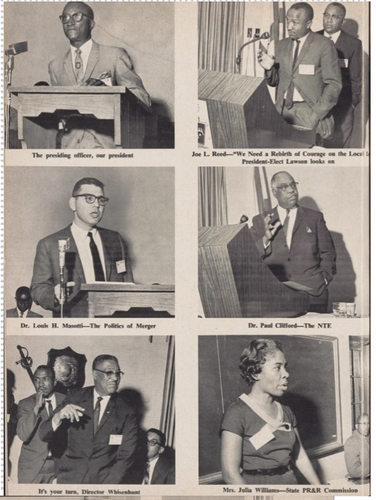
Pictures from the Arkansas State Teachers Association Leadership Conference that highlights the Professional Rights & Responsibilities Committee.
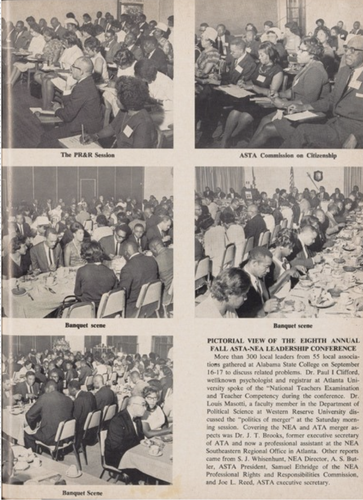
Pictures from the Arkansas State Teachers Association Leadership Conference that highlights the Professional Rights & Responsibilities Committee.
CTAs also held significant capital through their physical headquarters, often located at historically Black colleges and universities (HBCUs), as well as their covert engagement with the National Association for the Advancement of Colored People (NAACP) and curricular collaboration Association of the Study of African American Life and History (ASALH). Under the constellation of the American Teachers Association, CTAs embodied the muscle of the Black teaching body, growing in elasticity, strength, and endurance decades before the passage of Resolution 12 and the selective recognition by the NEA.

The American Teacher Association Bulletin Vol. 20, No. 4 (gut50000c03891) Group photograph and description of the 41st Annual Convention of the American Teachers Association in 1944.
Resolution 12 didn’t just happen to Black teachers in 1964; they were actively participated, reacted, and resisted. Similar with the Civil Rights Movement, Black teachers were instrumental to the passing of Resolution 12. The American Teachers Association, originally named as the National Association of Teachers in Colored Schools (NATCS) (until 1937), was the premier organized body that connected and represented state-affiliated CTAs across the nation, to “further opportunity for the education of black youth and adults”.xvi When the ATA collaborated with the NEA, it did so through committees like “Committee on Educational Problems in Colored Schools” in 1926, later morphing into the Joint Committee in 1928, that later helped passed Resolution 12.

For example, ATA-NEA Joint Committee took recommendations that “Negroes be fully integrated into the NEA.” In 1948, Black delegates from dual-state teacher associations were allowed to become convention delegates, setting a precedent for Resolution 12 in 1964 and the merger between ATA and the NEA. And, until 1978, Black teachers diligently advocated and fought for the best deal they could get on the books to “decry absorption”, and ensure preservation of institutions they had built over a century to sustain Black education.
Resolution 12 was neither neutral nor apolitical. In the early 1960s, NEA faced increasing backlash for its "deliberate slowness" in response to the 1954 Brown v. Board of Education decision, only endorsing it in 1961. Meanwhile, their counterpart, the American Federation of Teachers (AFT) integrated its membership as early as 1955.
This, compounded with Black teachers outcries over about lack of representation and protections from NEA impacting viability to the profession, incited NEA to eventually follow suit. Due to fears of alienating its White southern base by endorsing Brown, the NEA's “bureaucratic foot-dragging” meant that passing an integration mandate like Resolution 12 took until 1964.

Notably, at the 102nd NEA Convention, where Resolution 12 was passed, Elizabeth Koontz of the North Carolina Teachers Association made history as the first Black president-elect of the NEA. During her presidency, Koontz was instrumental in creating the NEA Task Force on Human Rights and the Subcommittee on Civil Rights and Human Rights in Education, which was led by Samuel Ethridge, the first Black member of the NEA Cabinet. President Koontz also allocated funds for the DuShane Fund for Teacher Rights.
At the 1966 National Council of State Teachers Association (NCOSTA) meeting, described as a "catharsis", participants voiced concerns over Resolution 12 and “perfected plans to the protect cause of Negro teachers.” Some CTA leaders, like Dr. Horace E. Tate, began to interpret Resolution 12 as “merely a ruse to destroy the black groups and rid themselves of burdensome problems being forced [to] their attention.” Ultimately, the NCOSTA decided to support Resolution 12 as the ATA-NEA committee had already begun the processing officially dissolving the ATA in 1966.

Newspaper clipping from The Louisiana Weekly, showcasing an NCOSTA meeting in 1966, with photograph including prominent CTA leader.
When it was time to vote on Resolution 12 in 1966, which aimed to merge the ATA and NEA, delegates from both associations participated. Notably, ATA delegates voted 100 in favor, 78 opposed, and three neutral, while NEA delegates voted unanimously for Resolution 12. With this outcome, the ATA officially consolidated into the NEA.

Bulletin of the Arkansas Teachers Association Vol. 35, No. 4 Clipping showcasing photo of the signing of implementing Resolution 12 for the American Teachers Association.
When it was time to vote on Resolution 12 in 1966, which aimed to merge the ATA and NEA, delegates from both associations participated. Notably, ATA delegates voted 100 in favor, 78 opposed, and three neutral, while NEA delegates voted unanimously for Resolution 12. With this outcome, the ATA officially consolidated into the NEA.

ASTA News Vol. 13, No. 3 (gut50000c03997) article discussing the new criteria for Resolution 12, including introduction of the compliance committee.
In this symbolic move, ATA president R. J. Martin urged the 11 other CTAs (and its 96 local affiliates) to “disembark at the shore.” The ATA-NEA merger was viewed to “influence the sub-level organizations to imitate [their] action.”
However, another ATA spokesperson admitted they weren’t “merging on an equal basis” — a “pyrrhic victory” indeed. An establishment of a compliance committee was also announced to “monitor and supervise the merger plans of the remaining dual state affiliates.”
Within members within CTAs themselves, there were many Black leaders who voiced their support and fears for Resolution 12 and its impact. For example, in 1965, members of the Florida State Teachers Association had different opinions.

Members of the Florida State Teachers Association discuss the “pros and cons” of merging.

Members of the Florida State Teachers Association discuss the “pros and cons” of merging.
“A Moment of Protest”…: Resolution 12 On the Ground
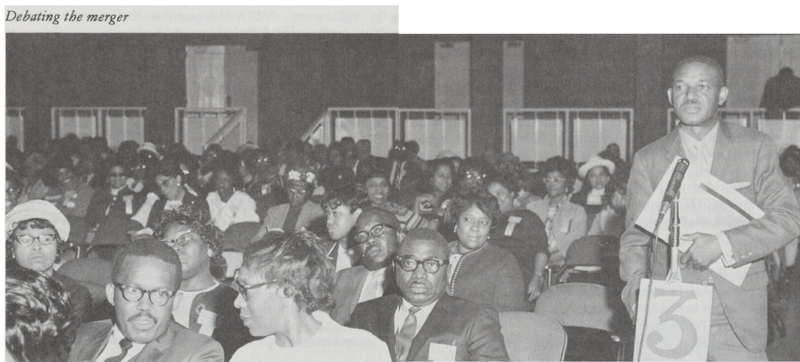
Black teachers, including the Liaison Committee, debating the merger at the North Carolina Teachers Association annual meeting.
Overall, Colored Teacher Associations (CTAs) were not vehemently opposed to Resolution 12, largely aligning with the "integrationist spirit of the times." However, skepticism on the implementation of the integration mandate did still loom.
The first five states to meet with the June 1, 1967 deadline for “Resolution 12-66” were Florida, Texas, Virginia, Tennessee, and South Carolina.xxxix The CTAs in these states faced designated dissolutions or/termination as well as loss of their journal publications, while the White teacher associations retained theirs.xl The interpretation, and initial implementation of Resolution 12 was fraught with flaws, compounded by a lack of mediation from NEA, though “periodic evaluations” were promised to respond to Black teacher concerns.
When CTAs and their White counterparts began implementing Resolution 12, they encountered a historical backdrop of racial animosity from White teacher associations. Mind you, these were the same associations that previously rejected Black teachers for membership and even going to court to oppose salary equalization--so imagine being positioned to now have to bargain and gleefully unite.xlii This was a heightened “period when intimidation of black people was the rule, rather than the exception, and reprisals applied equally to school principals and teachers” during merger negotiations.
In Texas, the Black Teacher Association received a “Certificate of Dissolution,” and referred to their “merger” as a “termination”.
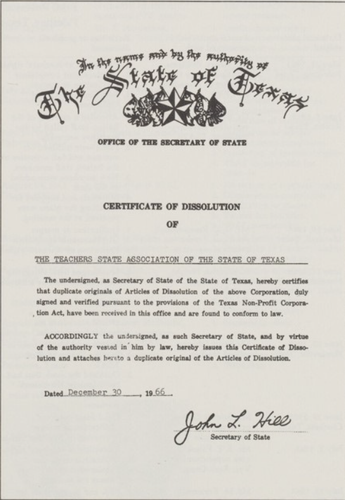
A copy of the “Certificate of Dissolution of the Teachers State Association of the State of Texas” in 1966.
The Virginia Teachers Association (VTA), a nearly century-old institution, dissolved into the White-majority Virginia Education Association within a year in 1967. When they merged, there was no formal announcement of the “merger” or acknowledgment of the VTA, despite an “understanding” and a “written schedule.”
These cases were neither isolated nor ignored. Many CTAs, united in their struggle, confronted the reality that once the dissolution took place, the words on the agreements quickly ran off the margins, and the invisible ink of the ethics and intentions of the white-majority associations painfully appeared. The surviving CTA leaders’ trust in Resolution 12 began to further wane as they observed that the NEA gave “the impression of solidarity” but ultimately knew “it was coming” for them too.
By the time of the 1968 Representative Assembly, six states remained as holdouts: Alabama, Arkansas, Georgia, North Carolina, Mississippi, and Louisiana. CTAs were apprehensive and resistant to implementing Resolution 12 in its current form, especially in light of what they saw happening with other CTAs, as well as the lack of compromise and collaboration from unyielding and racist White teachers’ associations.
The struggle to comply with Resolution 12 became especially urgent due to the Resolution 12 stipulation to penalize associations that failed to merge by the many set deadlines. Penalties included suspension, disaffiliation, and the loss of federal or state sanction, effectively putting a “lock” on Black teachers.
However, the threat of NEA disaffiliation was only one of the pressing factors in their decision-making and discourse. Black teachers were concerned about representation, ownership of their assets, the inclusion of committees and commissions, and the integrity of their profession.

Pages from the President of the Mississippi Teachers Association discussing updates on the potential merger and its impact on Black teachers.
However, the threat of NEA disaffiliation was only one of the pressing factors in their decision-making and discourse. Black teachers were concerned about representation, ownership of their assets, the inclusion of committees and commissions, and the integrity of their profession.
This next phase of Resolution 12 also required dual-state associations to establish their own committees, including joint committees. For example, the Alabama State Teachers Association created a grievance committee to review suspected violations of civil or professional rights during the merger. However, the structure of these joint committees varied across the CTAs.
In Arkansas, for instance, the Joint Committee formed in 1966 was not evenly split between the all-Black Arkansas Teacher Association (ATA) and the all-White Arkansas Education Association (AEA). The committee comprised eight members from the ATA, while the AEA had 11 representatives. Moreover, the AEA, like many white teacher associations, rejected several recommendations from the ATA, causing negotiations to come to a standstill.lv Eventually, in 1969, right before the deadline, Arkansas Education Association and Arkansas Teacher Association finally resolved and agreed to merge, but not without Arkansas Education Association retaining their name.

North Carolina Teachers' Record Vol. 38, No. 4 Merger Plans presented at the delegate assembly in 1968 for North Carolina State Teachers Association.
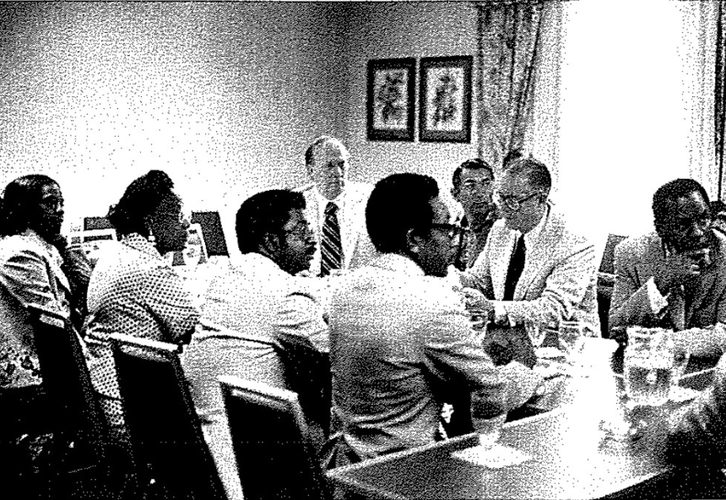
Picture of the joint committee between the Louisiana Education Association and Louisiana Teachers Association in 1975.
Given the stakes involved, the formation of joint committees became a critical arena for Black teachers to voice their concerns and negotiate terms that would benefit them and their futures. Black teachers found themselves in a precarious structural position during these negotiations, often outnumbered and having to navigate racial subjugation and power dynamics, while also facing the threats of erasure and unemployment. Their insistence on establishing and maintaining the Professional Rights and Responsibilities (PR&R) Committee, securing access to the NEA DuShane Emergency Fund or NAACP Legal Defense Fund post-merger, and obtaining guarantees of leadership positions, along with non-profits to store finances was consequential for Black teachers—many of whom were involved in lawsuits to protect their jobs, some defended by Supreme Court Justice alongside Thurgood Marshall.
Moreover, each CTA had its own assets that needed protection and accounting —thousands of dollars, decades of building and rebuilding headquarters, and archives that ensured their legacy. Thus, these joint committees served as the NEA-officiated site for their communal grievances to translate into stated stipulations within these merger agreements. lviii
By the January 1st, 1969, deadline, all but three states had merged their race-affiliated teachers' associations: North Carolina, Mississippi, and Louisiana.lix

Page from Mississippi Teacher Association official organ announcing suspension from NEA due to White teacher association rejection of merger plan.
All three states were denied representation at the subsequent NEA convention, including the all-Black North Carolina Teachers Association until accepting a plan to merge by 1970.lxi Amidst disaffiliations and suspensions from the NEA, several years of contentious meetings, fact finder reports, lawsuits, and inner-associational tensions among Black leaders regarding the future of their profession undergird by Resolution 12, both Mississippi and Louisiana finally merged in 1976 and 1978.lxii But these mergers didn’t happen without Black teachers invoking chaos on the scripts of compliance that was etched in Resolution 12, in word and practice.


Black Teachers Post-Resolution 12
While many CTA members and leaders weren’t satisfied with the results of the merger agreements, they insisted on being active in this new normal. Unsurprisingly, similar to the situation with Brown v. Board of Education, the NEA’s attempt to “bargain in ‘good faith” failed to take into account the burden it would place on the Black teacher professional body, as well as the power dynamics that undergirded their structural and social position within the racial order in education. Many merger agreements had an expiration date, and so did the “good faith”; Black members of the new association often did not retain leadership positions as promised.

History of the North Carolina Teachers Association Details the ten-year agreement regarding representation for the merger between North Carolina Teachers Association and North Carolina Education Association, to become the North Carolina Association of Educators in 1970.
For the newly merged Georgia Association of Educators, as the specified nine-year interval for electing a Black president approached its end without the election taking place, Black teachers expressed their concerns: “If we were being mistreated before the merger agreement is up, what will happen when it expires?”
In Louisiana, Black leaders of the Louisiana Education Association noted that the disadvantages of the merger included the loss of kinship among Black teachers, as well as a decrease in membership, as many felt “uncomfortable,” unheard, and unrecognized in the leadership.
Black teachers in the West Virginia Education Association (that merged in 1959) convened to establish in 1972 to renegotiate and secure their representation in leadership positions, following years of underrepresentation and neglect to their concerns. Black teachers in the West Virginia Education Association convened to establish Black Caucus in 1972 to renegotiate and secure their representation in leadership positions, following years of underrepresentation and neglect to their concerns. The Black Caucus sprouted considerable success, including hosting parliamentary workshops and helping elect Black president in 1977.
However, in Tennessee, they described the dissolution into the White teacher association in 1967 as “a newly married couple…well on the road to complete recovery from our minor ills to a happy, profitable, and lasting married life.”lxx Thus, the realities of Resolution 12 looked different for each CTA and each Black teacher.
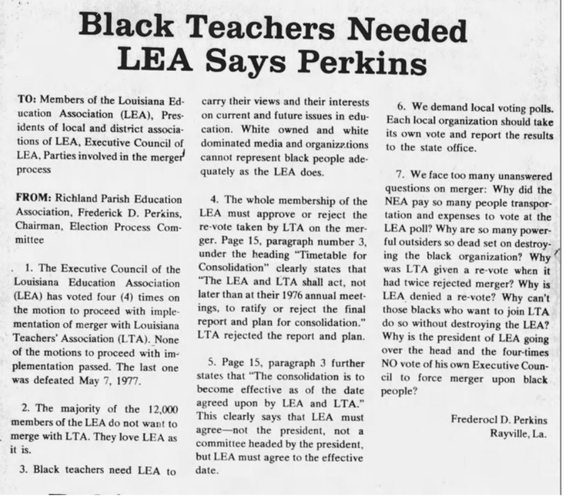
Newspaper clipping from The Monroe Dispatch in 1977 featuring a letter from a leader of a Black teacher association affiliated with the Louisiana Education Association, opposing the merger.
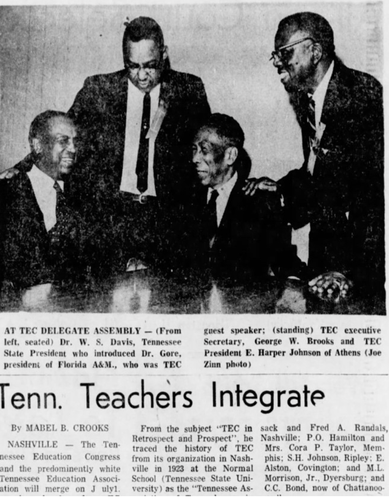
Newspaper clipping announcing “merger” between Tennessee Education Congress and Tennessee Education Association in 1977
In multiple states like Georgia and Louisiana, post-Resolution 12, Black teachers' participation in these associations dwindled as the promises made in the agreements did not come to fruition. In fact, the concerns raised by Black teachers in the dissolved or merged associations were “for the most part being ignored due to the pretense that they didn’t exist.”
It should be acknowledged that not a single merger resulted in the retention of a Black teacher association name; however, 12 White teacher associations kept their names. The loss of these associations’ names signifies a colossal rupture and disintegration of Black teacher associations, exacerbated by the implementation of Resolution 12.lxxiii
There was (and is) a loss, and we must account for it.
The Arkansas Teachers Association’s credit union…gone.
Florida State Teachers Association’s newly built headquarters…disposed.


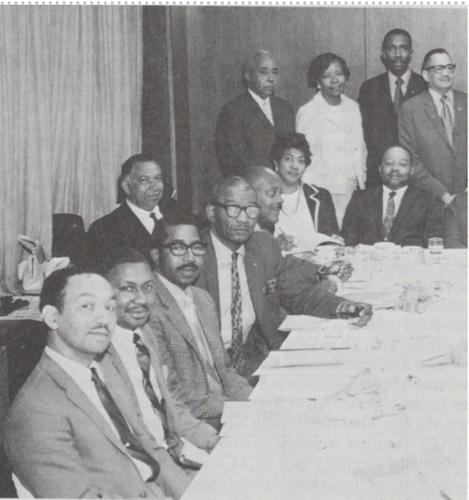
Photo of the Board of Directors of the proposed Hammocks Beach Expansion Development, spearheaded by the all-Black North Carolina Teachers Association in 1970, months before the merger.
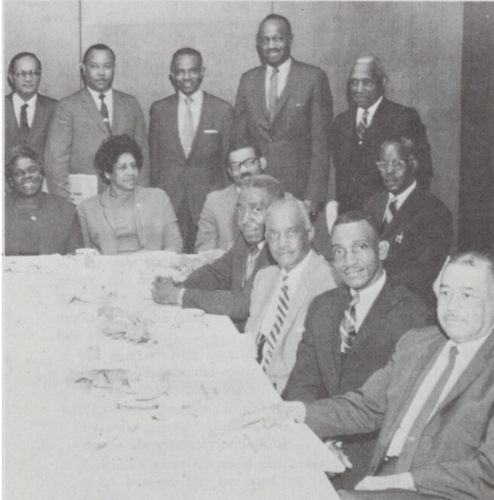
The project was not discontinued, and the property was “taken away for tax purposes or through state condemnation.
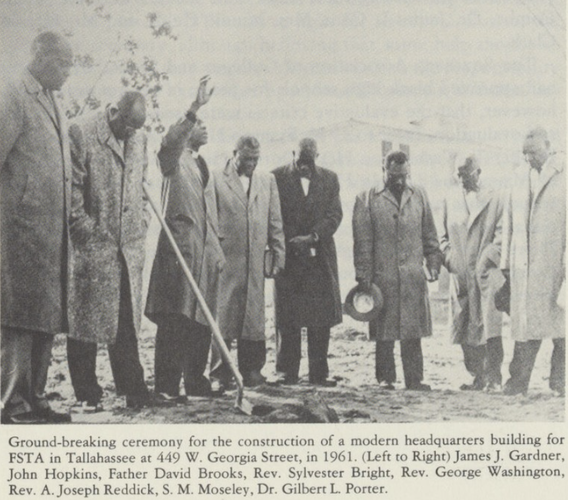
Photo of the ground-breaking ceremony for the new Florida State Teachers Association headquarters in 1961, three years before Resolution 12 and five years before the dissolution of the association.

“As We Disembark at the Shore” – A Conclusion
In summary, although Resolution 12 was perceived as a mechanism for integration, it ultimately led to the disintegration of Black teacher associations. While facing displacement, demotion, and racial domination, Black teachers, who at the time were the largest Black professional group, had to forgo their organized networks that “loved [them] enough to fight [their] daily battles.
Resolution 12 reflects the story of the destruction of Black associational life in the 1960s and 1970s. Therefore, Resolution 12 should not be viewed as a mere footnote in the historiography of Black teachers but rather as a watershed moment.
By utilizing materials from the Black Teacher Archive (BTA), we can better understand that Resolution 12 “effectively removed a power base for Black teachers that has not been replaced”—a narrative often overlooked in contemporary efforts to recruit and retain Black teachers. To dutifully commemorate the CTAs, we must also complicate how we name and understand Resolution 12 as part of their stories and what that can prescribe for us today.
This digital exhibit serves as a door to the House of the Black Teacher Archive (BTA), inviting us to continue exploring and excavating the legacy of CTAs while training our attention on Resolution 12's hidden injuries.
As the BTA recovers, the material calls on us to remember.