
Archive in Blue
“This blue-black living and doing is a bittersweet virtue, mastery in heartbreak, and raw laughter from the underside. We people who created a sound for the world’s favorite color—the blues—offer a testimony.”
― Imani Perry, Black in Blues: How a Color Tells the Story of My People

Digital exhibit curated by Erica Buddington.
Blue is a throughline. We knew this before and most certainly after reading Imani Perry's Black in Blues: How a Color Tells the Story of My People. The book of essays traces Black people's connections to the color blue across religion, cobalt blue bottles, blue paint, indigo dyes, George Washington Carver's infatuation with Egyptian blue, the blue-back speller, and so much more — blue as beauty, blue as labor, blue as the deepest register of a people's feeling. The journals of the Black Teacher Archive hold their own blue. Here, we gather the traces: the blue ink of resolutions, the blue ribbon of children's achievement, the blues heard through open windows on a Friday afternoon, the blue of feeling that never left the body of the work.
Blue be varied. These are real entries pulled from the journals of Colored Teachers' Associations across the South, digitized and held in the Black Teacher Archive. In these pages, the color appears on its own: in a chemistry lesson, in a prayer, at a coronation, in the memory of a continent.
Blue in the Journals
Blue is an object with a history. What the color touched in these classrooms, ceremonies, and counties tells you something the lesson plan never recorded.

"The queen wore a navy blue gabardine suit and carried a bouquet of red carnations."
Virginia State Teachers Association — Virginia Teachers Bulletin, Vol. 21, No. 3, May 1944

"Iron rust on clothes caused by bluing containing Prussian Blue reacting with soap left in water."
Virginia State Teachers Association — Virginia Teachers Bulletin, Vol. 15, No. 2, March 1938

"Some of their colors are indigo blue, known as gara, this color is used almost entirely by the Timne."
Virginia State Teachers Association — Virginia Teachers Bulletin, Vol. 21, No. 3, May 1944
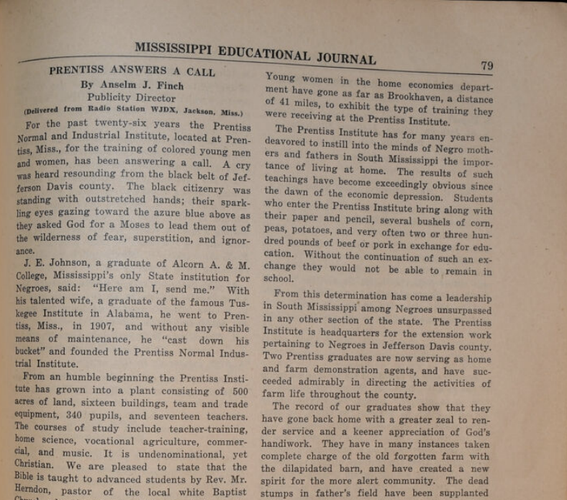
"Sparkling eyes gazing toward the azure blue above as they asked God for a Moses."
Teachers Association — Mississippi Educational Journal, Vol. 10, No. 4, January 1934
Things In Blue
Blue is an object you could hold. The best writers in a Goldsboro classroom carried it home on their chest. The most powerful Black educators in America sat on a committee named for it. Grandfathers and grandmothers opened the language through it. Soldiers were buried wrapped in it. The same color placed on ribbon, speller, and uniform moves across a century of Black educational life, in these articles, changing what it meant each time someone picked it up.
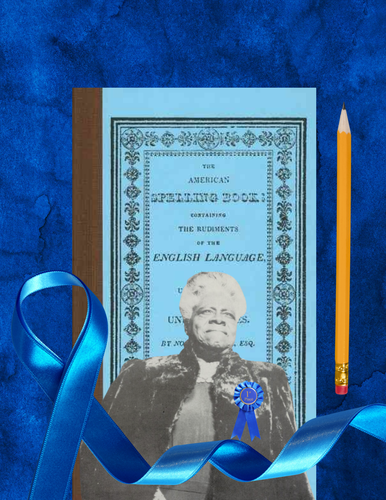
Blue ribbon, blue book, pencil, and Mary McLeod Bethune collage.
Blue Ribbon
In March 1946, Miss Sadie B. Grantham, a beginners teacher at School Street School in Goldsboro, North Carolina, organized a three-week dictionary project with her class. Children brought pictures, cut them out, matched them to words, and practiced writing stories for every letter of the alphabet. At the end of the first week, she held a writing contest. The class was divided into three groups. Each group's papers were judged by their supervisor. The "best writers" in each group wore a blue ribbon home.
Blue Uniforms
In May 1967, Dr. Donald C. Lord wrote in the PEA Journal about the invisible history of Black Americans in the making of the nation. Among his evidence: in the American Civil War, over 186,000 Black men donned the blue uniform to strike a blow for the Black man's freedom. Negro regiments composed twelve percent of the victorious Union Army. One-third of those soldiers were buried in the blue they valued so highly.
Blueback Speller
In January 1942, O. A. Dupree, principal of Pitt County Training School in Grimesland, North Carolina, wrote about the state of schoolhouse planning across the state. Describing schools that had gone unchanged for generations, he noted that in some communities the same building still stood in which fathers and mothers, even grandfathers and grandmothers, had studied the old Blueback Speller.


Blue is what stays. These journals were never meant to be monuments. They were working documents: sent by mail, read at meetings, passed between teachers who had too much to do and not enough time to do it. The blue that appears in their pages was not placed there for us. We found it anyway.
That is what an archive is for.