The Educational Life of Elijah P. Marrs and the Formalization of Black Teachers in Kentucky
Exhibit curated by Jordan Jackson-Collins.
Online Adaption by Erica Buddington.
Donning the Veil
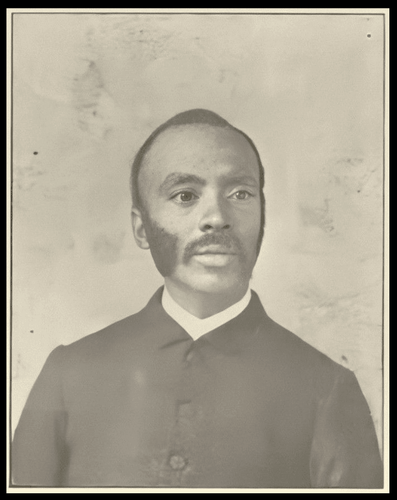
Sgt. Elijah P. Marrs Company L 12th U.S. Colored-Heavy Artillery
The Educational Life of Elijah P. Marrs and the Formalization of Black Teachers in Kentucky derives from W.E.B. Du Bois and his original conception of the "veil." In The Souls of Black Folk, he explains this "gift of sight" or double consciousness: "One ever feels his twoness, –– an American, a Negro…This longing to attain self-conscious manhood, to merge his double self into a better and truer self."
Black educators of the 19th century American South were, in essence, working to prepare themselves, their students, and their communities for a world in which they could not yet see––a world in which academic and intellectual import would be offered to the experiences, expressions, and consciousness of Black people in America. With this, it becomes important to understand the distinct social formations of Black educators born into the last generation of slavery; their conceptions and praxes of education as a decided method to disrupt the social and political realities of legal bondage and Jim Crow; and most of all, the figures, institutions, and educational organizations to emerge in later generations as scions of this tradition.
This exhibit situates a key figure in Kentucky's history of Black education, Elijah P. Marrs, as one who "donned the veil." Born enslaved in 1840 Kentucky, Marrs' purposing of literacy during bondage and his development as an educator following service as a Union Sergeant in the Civil War are teachable instruments. Not only does his educational life show us that there were indeed shapers of Black education prior to the most widely known of the late 19th and 20th centuries (e.g., Woodson, Bethune, Johnson, etc.), but it helps us understand how networks of Black teaching and learning in late antebellum Kentucky set the stage for the Colored Teachers Association (CTA) in the wake of emancipation.
The Kentucky Negro Educational Association
For nearly 100 years prior to the Supreme Court's pivotal 1954 Brown v. Board of Education decision to desegregate public schools, Black teachers, principals, university presidents and other professionals worked together in CTAs across the South. These interdisciplinary groups advocated for an end to unequal education policy, to create networks of information, strategy, and support among Black educators, and most importantly, to bring about meaningful education for Black student-youth. Under the strain and confines of a legally segregated society, CTAs were in many ways the heart and soul of Black teaching and learning in the South.

The Kentucky Negro Education Association, 1877-1946
In Kentucky, the Colored Conventions of the 1860s, '70s, and '80s were at the forefront of Black education. First called together at the close of the Civil War by politically organized free and formerly enslaved African Americans, these conventions often met in courthouses and other state buildings to remedy the still lingering injustices of anti-Black legislation and white racist mob-violence across the state. Of the resolutions to come out of the 1869 and 1877 conventions, two identify education for Black youth in Kentucky as their purpose. Minutes from the 1877 assembly gave birth to the State Association of Colored Teachers (the first CTA in Kentucky, later renamed to the Kentucky Negro Educational Association) and determined "That the teachers and trustees of each county be immediately requested to organize a 'County Teachers Association,' an Institute auxiliary to the State Association…"With this, members of the convention promptly acknowledged the need for teacher training. In a 1946 issue of The K.N.E.A. Journal, writer and former president H.C. Russell elaborated on this early challenge: "Second only to the opening and housing of the newly created schools was the problem of finding teachers to man them." A mere supply of teachers was one thing––systematically producing a corps of highly trained and well-educated Black teachers another.
While these County Teacher Associations worked in conjunction with the much larger state association, they functioned more like localized symposiums than far-reaching conventions, focusing specifically on the art of instruction and professional development of Black teachers.
Colored Teachers Institute

Photograph taken by Martin F. Schmidt, Green Street Baptist Church, University of Louisville Digital Collections, 1956-1966. Accessed Aug 1, 2024.
For what appears to be almost all of 1887, Kentucky native Elijah P. Marrs operated as president of Louisville's Colored Teachers' Institute (CTI). While the much larger State Association of Colored Teachers generally held their conventions in large theatres, state buildings, and convention halls, Louisville's CTI met in Green Street Baptist Church. This is a clear indication of the Black church as "the great center for the Negro's activities," this particular institution's legacy as a hub for Black political and educational activity in 19th century Louisville, and the grassroots approach of the CTI.
Not unlike the presidents of the much larger CTAs, Marrs can be seen calling the sessions to order, facilitating lectures, and addressing teachers himself. At the February 27, 1887 meeting, topics ranged from The Life of Thomas Jefferson to The Necessaries of Education; Marrs spoke to The Theory and Practice of Teaching. Extending far beyond the "three Rs," teaching and learning among Black communities have historically been a matter of moral and political significance.
For Marrs, who was born enslaved, the theories and practices he brought to the profession were first shaped by the contours of chattel slavery.
Two Buck Negroes
Slavery and literacy are often understood to be a contradiction in terms. By most popular accounts, not only was literacy a threat to the White power structure of the day, but worse, Negroes were simply thought incapable of reasoning. As Thomas Jefferson explained: "I think one could scarcely be found capable of tracing and comprehending the investigations of Euclid; and that in imagination they are dull, tasteless, and anomalous."
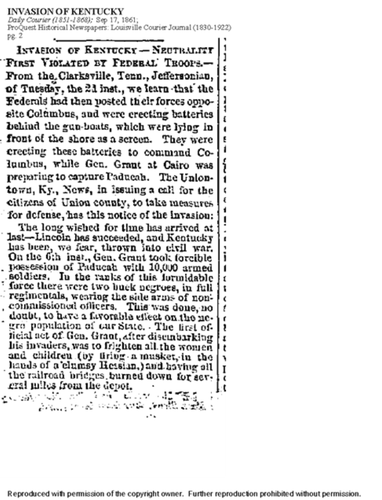
Invasion of Kentucky (Daily Courier, 1851-1868, Sep. 17, 1861, ProQuest Historical Newspaper: Louisville Courier Journal)
While the enslaved were often regarded by the master class as both untroubled by their low (or no) station in life and thus suited for such a fate by God himself, the reality is that Black folk, many armed with the "veil," had been thinking ahead all along.
Despite his enslaved status, Elijah Marrs first made a name for himself as a reader, writer, and thinker on the Shelby County plantation in which he was born and raised. He explains in his postbellum slave narrative, "Very early in life I took up the idea that I wanted to learn to read and write. I was convinced that there would be something for me to do in the future that I could not accomplish by remaining in ignorance."
As the Civil War continued to unfold throughout the 1860s, Kentucky, having originally taken a position of strict neutrality, joined the fight as a Union ally in the fall of 1861. Marrs explains, "I would read the newspapers as I would bring them from the post-office, and I kept the colored population of the neighborhood well posted as to the prevailing news…I would read to them for hours at a time."
Black folk in Kentucky were not allowed to join the Union Army until 1864. But the article above, published in the Louisville Daily Courier on September 17, 1861, is indicative of the types of news coverage that Marrs could have potentially been exposed to. It narrates the first waves of Federal (Union) troops to enter the state, and emphasizes the "two buck negroes, in full regimentals, wearing the side arms of non-commissioned officers. This was done, no doubt, to have a favorable effect on the negro population of our state."
Enlisted
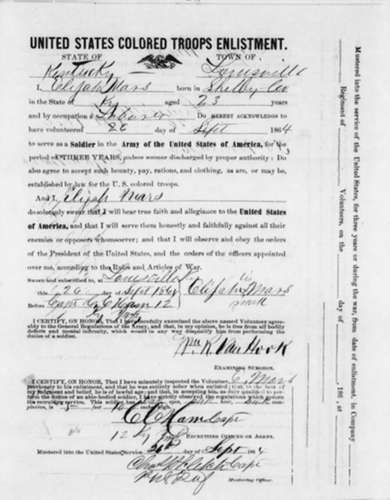
Elijah P. Marrs, Enlistment Papers, (Kentucky U.S. Colored Troops Project, Accessed Aug 1, 2024F
Marrs' distinction as a literate person appointed him to positions of leadership throughout his life. After deciding to escape slavery and enlist in the Union Army, he "had twenty-seven men, all told, and I was elected their captain to lead them to Louisville." At the Union Army camp in Louisville, Marrs quickly became venerated both by fellow escaped slaves and Union Army brass: "Soon the officers learned that there was a little fellow from Shelby County that was skilled in the use of the pen, and they sought to find me. They found me surrounded by a number of the men, each waiting his turn to have a letter written home. The officers soon made known their wishes, which was to find a man who was a penman who they wished as a Duty Sergeant."
Though the Normal School movement, a long priority of K.N.E.A., would not materialize with the State Normal School for Colored Persons until 1887, Marrs had long begun "to train industrial helpers and leaders," a distinct throughline of his educational service and vision of education at large.
The Dawn of a New Day
Marrs began his formal teaching career in 1866 after returning to Shelby County from fighting in the Civil War. With the reputation as one of the only learned Black folks in the area, he says "My friends at this time, knowing what I had endeavored to do for them in the past, importuned me to go to Simpsonville and engage in the teaching of their children… at this time we had no aid from the Freedman's Bureau, the parents paying one dollar a month for each child." Marrs went on to serve as a delegate for both the 1869 and 1877 State Colored Educational Conventions, both of which were squarely behind the advent of Black schools in Kentucky in a literal sense and Black schools of thought in the theoretical. Although slavery had been legally abolished and Black public schools began to flourish in urban areas across Kentucky, freedom did not mean liberty. Southern White racists, incensed by the Confederacy's lost-cause and what they perceived as Black progress, often put Black schools and teachers in their crosshairs––the dawn of a new day.
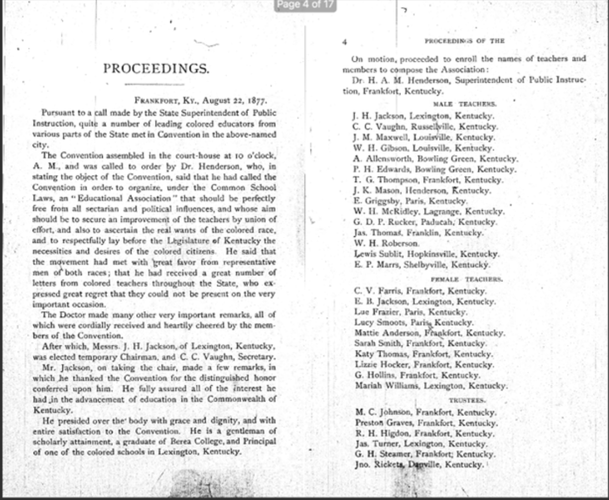
Proceedings of the State Colored Educational Convention Held at Frankfort, Kentucky, August 22, 1877, Colored Conventions Project, Accessed Aug 1, 2024
Much of Elijah's personal and professional life is a testament to the resilience Black teachers showed in the face of reactionary White mob violence. Not only did he combat racist attacks in a truest sense, but his brother and fellow Colored School teacher, Henry Marrs, served alongside him as a member of the Kentucky Colored Conventions. At the 1871 assembly, Henry served on the committee for the Memorial of a Committee Appointed at a Meeting of Colored Citizens of Frankfort, KY and Vicinity, Praying the Enactment of Law for the Better Protection of Life. The convention lists over 100 acts of murderous Klan violence perpetrated against Black individuals and communities, some of which involve attacks on Black schools. With this, the committee determined "that life, liberty, and property are unprotected among the colored race of this State" and implored the state government to intervene.
In this way, it is important to understand late antebellum Southern Black educators' efforts to mitigate the repercussions of slavery, bring about equitable and meaningful education for Black student-youth, and more broadly, to prepare the Negro for citizenry. Each of these facets of Black education were first carried out on plantations in a myriad of clandestine routines and later formalized by Kentucky's Colored Convention movement––the groundwork from which CTAs were built. We can view the educational life of Elijah Marrs and the connectedness between the Colored Convention movement and the building of CTAs in Kentucky as distinct phenomena. CTAs did not develop in a vacuum.
By focusing on the set of Black educators born into the twilight of slavery, witnesses to the contradictions of American democracy in both slavery and in freedom, we can better understand the centrality of Black teachers in the large Black freedom movement and, more specifically, gain an appreciation for Black education as an interpretive framework for African American history.