
Jeanes Teachers
He found her doing the work.
In 1905, Jackson Davis, superintendent of schools in Henrico County, Virginia, visited the Mountain Road School expecting to conduct a routine inspection. What he encountered instead was Virginia Randolph who was already teaching, already building a community center, and connecting the school to the lives of the people around it. Davis didn't discover Randolph. She was simply visible to him for the first time. And rather than leave what he witnessed where he found it, he asked: how do we make this a system?
Exhibit curated by Brittney Kilgore.
Edits and online adaptions by Erica Buddington.
Virginia Estelle Randolph
That question is the origin of the Jeanes Teacher program. When the newly formed Jeanes Fund financed Randolph's expansion from one school to an entire county, her individual practice became the template for a movement. By 1908, that model had reached Georgia — and it would not leave for sixty-two years.
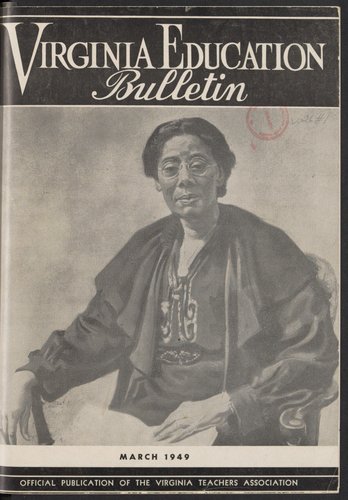
Portrait of Virginia Estelle Randolph, cover of the Virginia Education Bulletin*, Vol. 26, No. 1 (March 1949).
That question is the origin of the Jeanes Teacher program. When the newly formed Jeanes Fund financed Randolph's expansion from one school to an entire county, her individual practice became the template for a movement. By 1908, that model had reached Georgia — and it would not leave for sixty-two years.
This exhibit tells the Georgia story of over five hundred women who built a system inside a system, and what was lost when it was taken apart.
Focusing primarily on Georgia, this exhibit examines the contributions of three women whose careers embody the full range of what Jeanes work demanded: Helen A. Whiting, who built the intellectual and training architecture of the program in Atlanta; Susie W. Wheeler, who transformed Bartow County through community organizing and school construction; and Frances McBride, who served Athens-Clarke County for over two decades and was named Teacher of the Year in 1970; the program's final year.
Drawing on the Harvard Black Teacher Archive, The Herald: Georgia Teachers and Education Association Journal, and Jeanes Supervision in Georgia Schools: A Guiding Light in Education, a history of the program written by Jeanes Supervisors themselves, this exhibit recovers a legacy that shaped curriculum, teacher training, and community development across the rural Black South for sixty-two years.
Who Are The Jeanes Teachers?
Jeanes Teachers were Black, educated women funded by the Anna T. Jeanes Fund and later The Rural School Fund Inc. to establish health, educational, and financial resources for Black school families in the rural South between 1908 and 1970. The educators who worked on this endeavor evolved over time: a Jeanes Teacher served a single rural school, while a Jeanes Supervisor served multiple districts. What remained constant was the scope of the work.

The National Association of Colored Teachers Bulletin, Vol. 9, No. 2 (December 1928)
Their roles were never limited to delivering educational opportunities to children. Jeanes Teachers ensured that families in the rural South received healthcare ranging from dental care to maternal health care. They established funding opportunities for local farmers and planters so that community members could earn a living wage. They partnered with local entrepreneurs. They extended learning beyond the school calendar, offering education to children and families during seasons when crops were not planted. They implemented industrial education curricula while simultaneously advocating classical education that taught the whole child. They even assisted with fundraising to build and sustain schools, and the financial scale of that work was significant. W.T.B. Williams, Field Director for the Jeanes and Slater Funds, documented that "for a number of years, Jeanes teachers have raised annually for school improvement over half a million dollars. This money, raised in the main from colored people, is indicative of the influence the Jeanes teachers exert among their own people" (The Bulletin, p. 13).
That fundraising power was so substantial that the Rosenwald Fund, the multimillion-dollar initiative established by Julius Rosenwald to build rural Black schools, regarded the Jeanes teachers as their "most effective allies and assistants in the work of building schoolhouses."
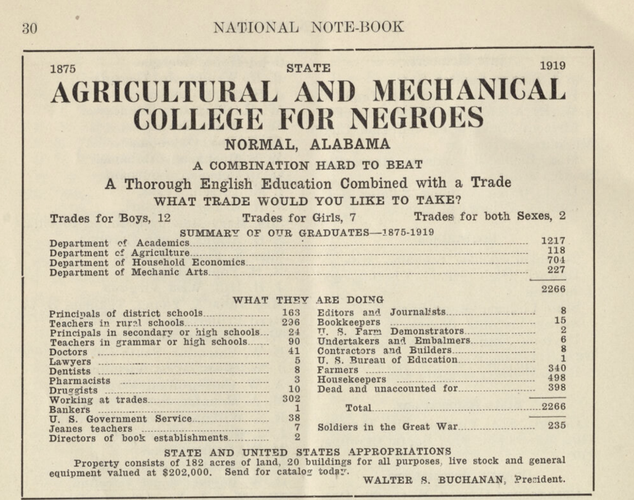
National Note-Book, Vol. I, No. 4 (October 1919)
In Georgia, Jeanes Teachers partnered with the Rosenwald Fund to build over 50 schools and implement curricula that centered on Black education. Their work was documented in journals including The Herald: Georgia Teachers and Education Association Journal and The Louisiana Colored Teachers' Journal, and profiles of both teachers and supervisors appear throughout the Black Teacher Archive.
Jeanes Teachers and the Rural South
Jeanes Teachers exclusively served in rural counties. At that time, rural districts were defined as areas with over 70% farmland, where most employment was in domestic labor and agricultural fieldwork. In contrast to urban areas with access to transit systems, water infrastructure, railroads, and hotels, rural communities operated with far fewer resources and far less visibility.
Jeanes Teachers used access to innovative fundraising networks to bring some of those resources into rural Georgia. They rallied allies, wrote letters to white county superintendents, attended local and state meetings, and used every available relationship to gain funding, permission, and materials for the schools they served. The work Jeanes Teachers provided across rural Georgia carried a spirit of possibility into counties where Black children had been told to expect less.
What They Built
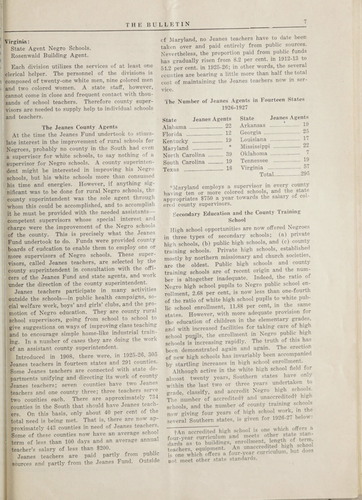
A 1926–27 issue of The Bulletin records 295 Jeanes Agents across fourteen Southern states — each number a woman doing the work the county superintendent could not.
Modeled after Randolph's example, Jeanes Teachers established National Negro Health Week programming, built wells for access to clean water, revamped school facilities, created maternal health programs, and planned annual dinners that brought together Black activists, entrepreneurs, and scholars. The Bulletin confirms that their labor extended well beyond classroom walls, documenting their involvement in "public health campaigns, social welfare work, boys' and girls' clubs, and the promotion of Negro education." They worked with county superintendents, district personnel, and curriculum directors to address the specific needs of rural South community members.
Their work was documented through reports, in-service bulletins, and the pages of The Herald. The Georgia Teachers and Education Association's own records confirm what communities already knew: no one reached more people or more consistently than the Jeanes Teacher.
The Fugitivity of the Jeanes Teacher
Jeanes Teachers attended local and national meetings to represent rural communities that would otherwise have had no voice at the table. Their advocacy reached school funding decisions, curriculum debates, and resource allocation conversations that directly shaped the conditions of Black education in Georgia.
Scholars including Darlene Clark Hine have described this dimension of their work as operating as "double agents," a framework later applied to Jeanes Teachers specifically to capture the way they moved between Black communities and white county officials, translating needs into requests, and requests into results. They wrote official letters to white state superintendents. They sat in GTEA conventions discussing new initiatives, then returned to rural counties and communicated those changes to parents, community members, and other educators. They used access, not deference, to get what their communities needed.
That dual navigation was not a compromise. It was a strategy. And it worked.
The Herald documented Jeanes Teachers at state conventions, in regional meetings, and in their roles as curriculum writers and reporters. The Georgia Association of Jeanes Curriculum Directors maintained records of their advocacy at every level of the system. Their presence in these spaces was not incidental. It became the mechanism.
Curriculum and Teaching
Jeanes Teachers were curriculum writers, in-service educators, and instructional leaders. In 1946, Helen A. Whiting's Planning Together, Following Through offered supervisors a framework for teacher observation, recruitment, and training. The Georgia Division of Negro Schools' The Open Road: A Teacher's Guide for Child, Adult and Community Development reflected the scope of what Jeanes Teachers were designing and delivering. Amber Caliver's 1933 federal bulletin, Rural Elementary Education among Negroes under Jeanes Supervising Teachers, documented the reach of the program nationally at a time when its Georgia chapter was already decades deep.
Programs Jeanes Teachers advocated for across Georgia included sewing, gymnastics, well-building, updated reading programs, choirs, and applied fieldwork. They ran study groups, trained teachers toward certification, organized School-Community Days so families could engage with curriculum changes and held commencement programs that encouraged students to continue from elementary through high school and on to college.
Georgia Jeanes Teachers
From 1908 to 1970, Jeanes Teachers were active in professional organizations beyond their counties. They held leadership in the National Jeanes Teacher Association (NJTA), the National Association of Teachers in Colored Schools (later the American Teachers Association), Black Greek organizations, local Colored Teachers Associations, the National Council for Negro Women, and district committees.
These affiliations were not ceremonial. Jeanes Teachers used national networks to access resources, materials, and information they brought back to the communities they served, funding initiatives, school advocacy councils, and rebuilding projects included.
At the national level, Jeanes Teachers served seventeen states across the South. Georgia Jeanes Teachers appeared on the rosters of major national convenings, including the 1949 National Association of Jeanes Supervisors (NAJS) Biennial Convention at Tuskegee Institute and the 1952 State Agents conference with representatives from fourteen Southern states.
Helen Whiting
Helen A. Whiting is the intellectual center of the Georgia Jeanes Teacher program. She became a Jeanes Supervisor in 1932 and served through 1943, working primarily in the Atlanta area. During that period, she built the program's training architecture from the ground up: in-service education networks, teacher observation systems, certification study groups, and community convenings that connected families to National Negro Health Week, college education, and ongoing professional development.
Her published guides gave Jeanes Supervisors concrete tools for identifying, recruiting, and developing teachers across Georgia's rural counties. Her scrapbooks, held at the Auburn Avenue Research Library, document the texture of a career lived in service to other people's possibilities.
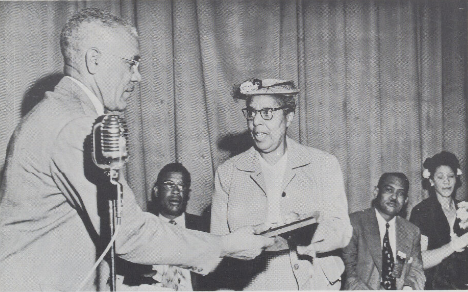
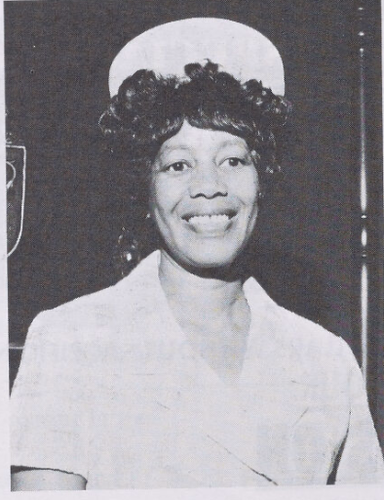
Frances McBride
Frances McBride served Athens-Clarke County for over twenty years. She was a mathematician who built her curriculum around the analytical and theoretical foundations of algebra and calculus, insisting that Black children in rural Georgia deserved to understand mathematics as a living tool rather than an abstract exercise.
In 1970, the final year of the Jeanes program, she was named the 15th GTEA Teacher of the Year in Region Four. She was recognized for after-school tutorials, in-service education support, and a teaching philosophy built on application rather than memorization.
Susie Wheeler
Susie W. Wheeler is the organizing force of Bartow County. She built Noble Hill School in 1920, served as a Jeanes Supervisor beginning in 1946, and participated on the National Committee of Georgia Jeanes Teachers. She attended county board meetings to request funding and materials, wrote in local newspapers to build public support, and organized construction projects that changed what was physically possible for Black children in her county.
Her doctoral dissertation from Atlanta University, completed in 1977 and preserved at the Atlanta University Center Robert W. Woodruff Library, examined the impact of Jeanes Teachers in rural counties. Noble Hill School is now a historic site dedicated to her legacy.
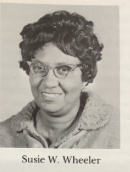
Picture of Dr. Susie W. Wheeler, Jeanes Supervision in Georgia Schools, Southern Education Foundation, 147, 4.
